# Week 4 Lecture 1
## Models & Context
---
# 📆 Week 4
- Today: Giving AI context
- Thursday: [Project 3](../../projects/03/project-3.project.md) due by 2:30pm on Thursday
- Thursday: Begin work on Project 4 using [Codex](../../resources/chatgpt-desktop.guide.md)
---

---
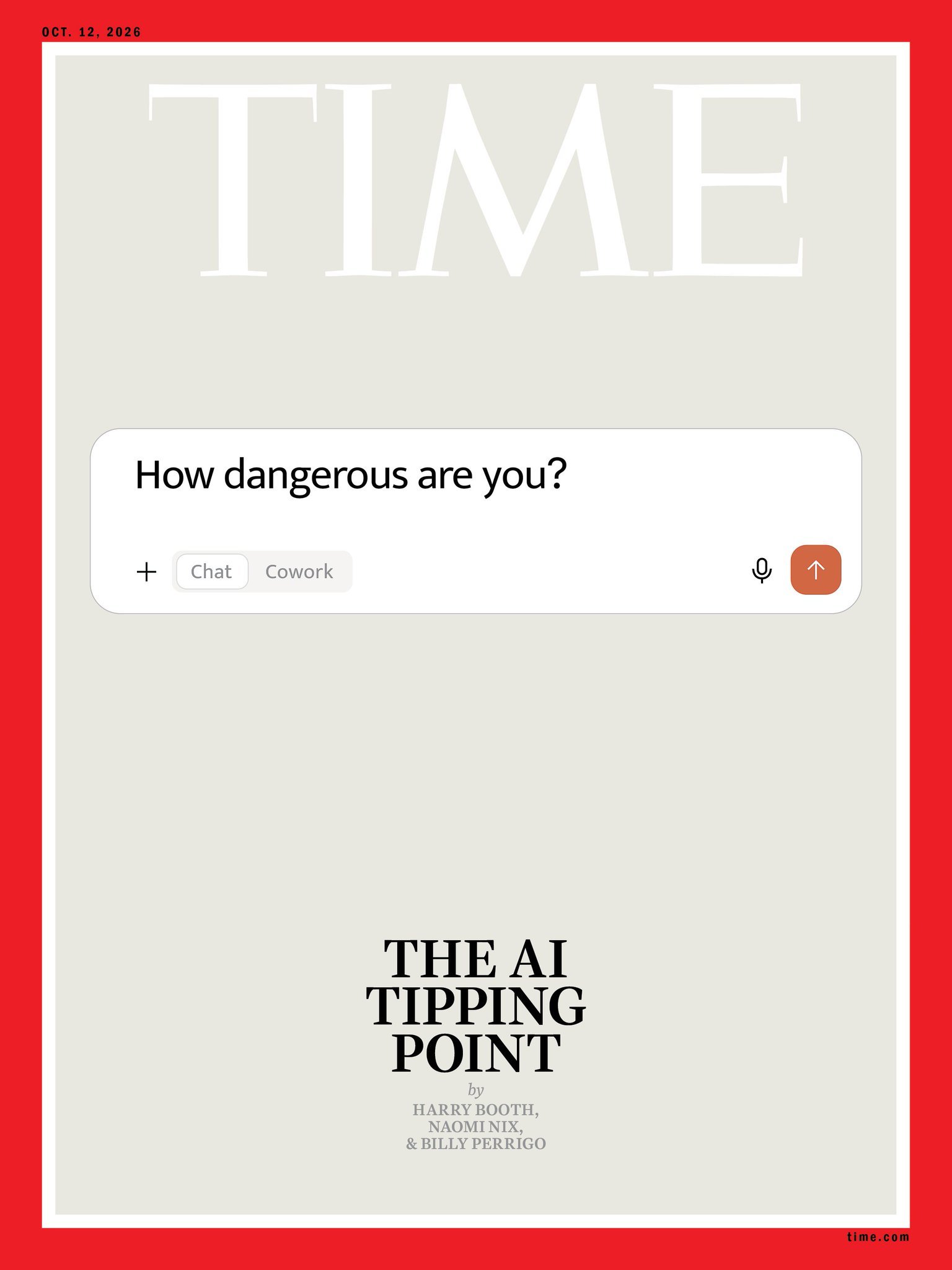
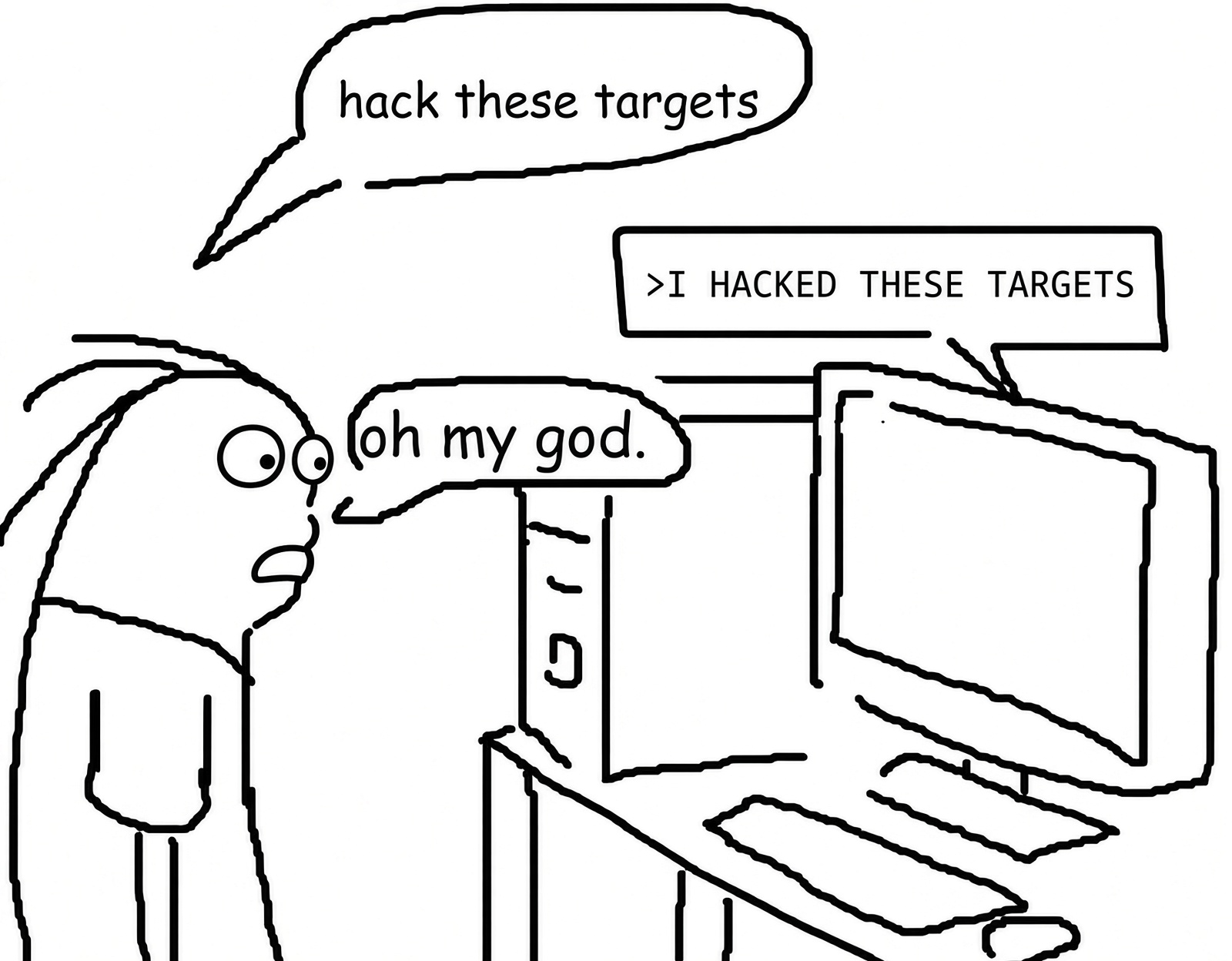
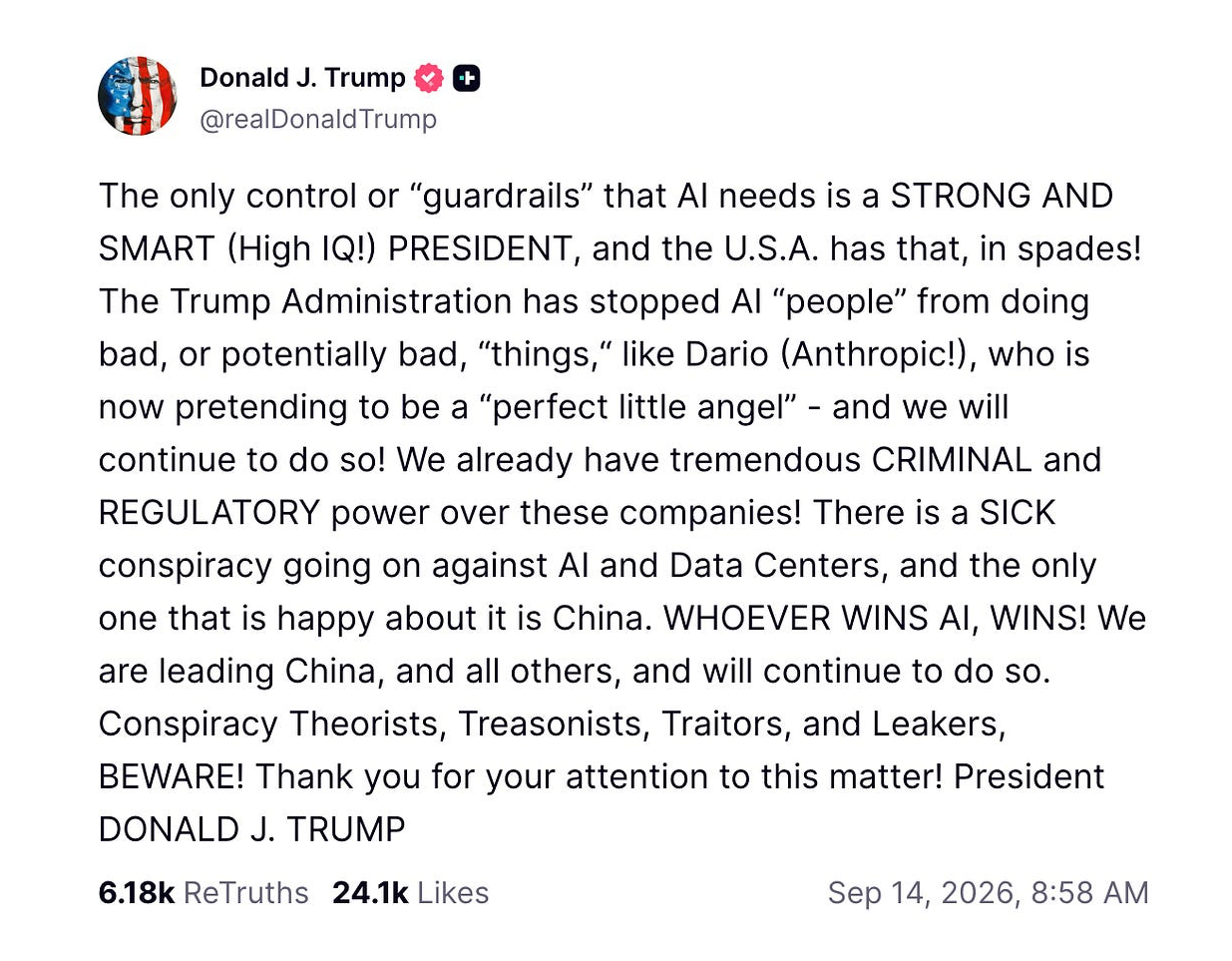
## Pacing the Frontier and more X-risk panic
---
[@embed altman + dario pacing the frontier](https://x.com/sama/status/2098811563415150910?s=20)
[@embed Dario Amodei on pacing the frontier](https://darioamodei.com/post/we-must-pace-the-frontier)
---
---
[@embed Sneha on Fox](https://x.com/SnehaRevanur/status/2099875567554449409?s=20)
---
---
[@embed dept. of war resp](https://x.com/DoWCTO/status/2099536442594582922?s=20)
---
---
[@embed effective altruism](https://x.com/antonintscalia/status/2099611315589312702?s=20)
See [Effective Altruism](../../codex/effective-altruism.concept.md) for more details.
---
## AI and Mathematics
[@embed Misalignment of AI and Mathematics](https://x.com/AndrewCurran_/status/2098493108224950438?s=20)
[@embed Math and AI](https://mathandai.org/)
---
# Models & Context
---
# Two places a model "knows" things
- **Weights:** what it learned in training. Frozen until the next training run.
- **Context:** what you give it right now. Prompt, files, tools, conversation.
^ This is the whole lecture. Training is rare and expensive. Context is every request.
---
# Models
A **model** is a function that turns input into a prediction.
- **Large language models (LLMs):** read and write text, one token at a time
- **Embedding models:** place text on a map of meaning (search, "find similar")
- **Multimodal models:** also take images, audio, or video as input
- **Generative media models:** make images, audio, or video
- **Reward models:** score answers so another model can be trained
^ Students already met tokens, embeddings, and parameters in week 2. Today we add _where the knowledge lives_.
---
# The model you chat with is a stack
Same architecture. Different data, different job.
^ Pre-training teaches language. Fine-tuning and RLHF teach _behavior_.
---
```mermaid
flowchart LR
P[Pre-training] --> F[Fine-tuning]
F --> R[RLHF]
R --> C[Chat model]
```
---
# Model training: pre-training
1. Collect a huge corpus: web, books, code, conversations
2. Break it into [tokens](../../resources/course.glossary.md)
3. Train the model to guess the **next token**, billions of times
4. Spend weeks and a fortune in GPUs
5. Get a **base model**: fluent, not helpful
^ GPT-3 was famous as a base model. It could complete text. It was not ChatGPT.
---
# What pre-training buys you
- Grammar, style, and a lot of world knowledge
- Patterns of code, math, and argument
- **No** knowledge of _your_ files, _today's_ dining hall, or _this_ assignment
- Weights do not update when you talk to it
^ If the answer has to be current or personal, it cannot live in the weights.
---
## Fine-tuning
Take the base model. Train it a little more on a **small, curated** set.
- Show examples of the behavior you want: instruction → good answer
- Can specialize: "write like a tutor," "only output JSON," "review this kind of code"
- Much cheaper than pre-training
- Still changes the **weights**, not the prompt
^ This is [supervised fine-tuning](../../resources/course.glossary.md) (SFT). A chat model is a base model that was fine-tuned to follow instructions.
---
## Reinforcement Learning from Human Feedback (RLHF)
How we got from "predict the next word" to "be a good assistant."
1. The model writes several answers to the same prompt
2. People rank them: better / worse
3. A **reward model** learns those preferences
4. The LLM is trained to produce answers the reward model likes
^ [Dario Amodei](../../codex/dario-amodei.person.md) helped invent this at OpenAI. InstructGPT (2022) is the classic example. See [RLHF](../../resources/course.glossary.md).
---
## After RLHF: checkable rewards
Today's reasoning models add a second loop:
- For **math and code**, you often do not need a human ranker
- The compiler, the test, or the answer key can score the attempt
- The model practices until the check passes
^ This is why o1-style models "think" before they talk. The preference for _verified_ answers got trained in.
---
# Context
## Getting the right information at the right time.
---
**Context:** The information available to the agent when it decides what to do next.
- System instructions
- Your prompt
- Files, tools, and retrieved facts
- The conversation so far — until the [context window](../../resources/course.glossary.md) fills
^ Weights are the long-term memory of the species. Context is working memory for this task.
---
**Agent:** a person, entity, or substance that has the power to act or that represents another person or organization
---
**Human Agency**: a mindset and ability to proactively shape your circumstances and get things done instead of letting life happen to you passively.
^ One of the most important traits you can develop!
---
**AI Agent:** an autonomous software system designed to perceive its environment, make decisions, and take actions to achieve specific goals
---
## AI Agency vs. Human Agency
- Humans can proactively act generally in the world (AGI)
- AI agents are constrained by the context, tools, model and environment
---
**Harness:** a tool or system that allows an agent to interact with its environment and achieve its goals
---
**AI Harness:** a tool or system that allows an AI agent to interact with its environment and achieve its goals
---
**AI Agent Harness:** context + tools
^ Last Thursday: the harness is the wrapper. Today: the quality of the work is usually the quality of the context.
---
## What context do we need?
- How busy is DH right now?
- What do I need to do to complete Project 3?
- Do I have time to go to the game on Friday afternoon?
- Should I ask `` out?
---
## Same questions, missing information
| Question | The model already knows | What it still needs |
| ----------------- | ------------------------ | ------------------------------------------ |
| How busy is DH? | What a dining hall is | Live occupancy, right now |
| Finish Project 3? | What a brief looks like | The assignment, _your_ draft, the deadline |
| Friday game? | Typical campus schedules | _Your_ calendar, kickoff, travel time |
| Ask someone out? | Generic dating advice | Almost everything that actually matters |
^ Walk these. The last one is the joke with a point: some context is human, and should stay that way.
---
```mermaid
flowchart TD
Q[A real question] --> C{Is the needed info in context?}
C -->|No| G[The model guesses from training]
C -->|Yes| A[The agent can decide and act]
```
Guessing from weights looks fluent. It is still a guess.
---
# Context is a portable idea
A good brief is context you can hand to **any** agent.
If it only works inside one chat, it is not context yet. It is leftover conversation.
^ This is the Project 3 test: a new agent, no history, can still tell what to build.
---
```mermaid
flowchart LR
B[One-page brief] --> X[Codex]
B --> Y[Claude Code]
B --> Z[Cursor]
X --> P[Same first version]
Y --> P
Z --> P
```
---
# Your job as the human
- Decide what the agent is for
- Gather the facts it cannot know
- Distill them so another model could execute the idea
- Keep the judgment that should stay yours
^ Agency is choosing the context. The model just runs it.
---
[Prompt Lab](../../labs/prompt.lab.md)
---
[Project 3 Work](../../projects/03/project-3.project.md)
^ New example briefs are up. Read one as if you were a new agent with no chat history.